
TAIWAN, September 4, 2026 — TAIWAN KING LUNG CHIN PTC CO., LTD. (KLC Corporation), a Taiwan-based thermal management technology manufacturer, today announced the global launch of TTV 2.0, a next-generation Standardized Thermal Test Vehicle (TTV) engineered for chip-level thermal simulation and cooling validation across AI servers, GPUs, CPUs, HPC systems, and advanced data center cooling architectures.
As AI accelerators and high-performance computing processors continue to reach higher power densities, accurate and repeatable thermal validation has become increasingly important for the development of next-generation cooling systems.
KLC TTV 2.0 provides engineers with a standardized yet customizable platform for simulating chip-level heat generation and evaluating the thermal performance of cold plates, liquid cooling systems, thermal interface materials (TIMs), and other advanced cooling technologies under controlled and repeatable conditions.
For more information, request the TTV 2.0 datasheet, or discuss customized thermal validation requirements, visit the KLC TTV 2.0 product page.
TTV 2.0: Standardized Thermal Test Vehicle with Customizable Thermal Profiles
Traditional thermal validation often relies on fully customized Thermal Test Vehicles. While these solutions can address specific testing requirements, they may involve longer development cycles, higher engineering costs, and repeated mechanical or thermal redesigns.
KLC TTV 2.0 addresses this challenge with a standardized yet customizable Thermal Test Vehicle architecture.
The platform offers standardized dimensions ranging from 30 × 30 mm to 80 × 80 mm, with two standard thickness configurations:
- Thick Plate: 8.5 mm
- Thin Plate: 6.0 mm
The standardized mechanical platform allows engineers to establish repeatable thermal validation procedures while retaining customization of key thermal parameters.
Depending on the application, TTV 2.0 can be customized for:
- Heating pattern
- Total power
- Power density
- Thermal load distribution
- Dimensions
- Temperature sensor configuration
- Multi-zone heating layout
This combination of standardization and customization enables TTV 2.0 to support different Device Under Test (DUT) configurations and cooling architectures without requiring a completely new thermal test platform for every project.
Low-Thermal-Resistance Design for High-Fidelity Thermal Testing
A key feature of TTV 2.0 is its patent-pending low-thermal-resistance structural design, which has been formally submitted for patent application.
The structure is engineered to minimize thermal resistance within the heat-transfer path and improve thermal coupling between the Thermal Test Vehicle and the cooling solution being evaluated.
TTV 2.0 also features an ultra-flat contact surface with a specified surface roughness of Ra < 0.4 μm, with an average value of approximately 0.16 μm.
By reducing surface-related contact resistance and improving thermal coupling, the platform is designed to provide more representative and repeatable thermal conditions for cooling validation.
This is particularly important when evaluating high-performance cooling technologies where small differences in thermal resistance can significantly affect measured thermal performance.
100% Built-In T-Type Temperature Sensors
Every standard KLC TTV 2.0 is equipped with 100% built-in T-type temperature sensors.
Unlike thermal test platforms that rely entirely on external or separately installed temperature measurement components, TTV 2.0 integrates temperature sensing directly into the thermal test platform.
The integrated T-type sensors provide engineers with real-time temperature data for evaluating:
- Cooling performance
- Temperature distribution
- Thermal interface material (TIM) performance
- Thermal resistance
- Thermal stability
- Hotspot behavior
The integrated sensing architecture also helps improve test consistency by reducing variations associated with manual sensor installation and positioning.
For engineering teams comparing different cold plate designs or liquid cooling architectures, this integrated measurement capability provides a more consistent basis for thermal performance evaluation.
Multi-Zone Hotspot Simulation for AI Chips, GPUs, ASICs, Chiplets, and HBM
Modern AI processors and high-performance semiconductor packages can generate highly non-uniform thermal loads. Localized hotspots may occur across GPUs, AI accelerators, ASICs, chiplets, and High Bandwidth Memory (HBM) structures.
TTV 2.0 supports advanced Multi-Zone Thermal Test Vehicle configurations designed to reproduce these non-uniform thermal conditions.
Standard configurations include:
- 15 independent power zones
- 25 independent power zones
- Custom zone layouts available upon request
Each heating zone can be independently configured according to required:
- Power (W)
- Power density (W/cm²)
- Heating pattern
This independent zone control enables engineers to reproduce localized hotspots and complex thermal distributions that more closely represent the thermal behavior of advanced high-power processors.
Multi-zone thermal simulation can be used to evaluate whether cooling solutions can effectively manage uneven thermal loads under demanding AI and HPC workloads.
Thermal Validation for Cold Plates and Advanced Liquid Cooling
The increasing power density of AI and HPC processors is driving the adoption of advanced cooling technologies, including direct-to-chip liquid cooling, cold plates, microchannel cold plates, immersion cooling, and two-phase cooling.
KLC TTV 2.0 provides a controllable thermal load that enables engineers to evaluate these cooling technologies without relying on an actual high-power processor as the heat source.
Typical validation applications include:
- AI server cold plate validation
- GPU cooling validation
- CPU thermal testing
- Microchannel cold plate evaluation
- Liquid cooling performance testing
- Thermal interface material (TIM) evaluation
- Hotspot thermal simulation
- Multi-chip and chiplet thermal validation
- Advanced data center cooling development
By providing a repeatable thermal load, TTV 2.0 can help engineering teams compare cooling architectures, identify thermal bottlenecks, and accelerate thermal design iterations.
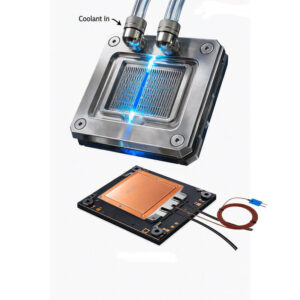
Integrated Mounting Solution for Repeatable Thermal Validation
KLC TTV 2.0 is designed as more than a standalone thermal test module.
The platform can be integrated with compatible cold plate fixtures using KLC-provided clamping pressure assemblies and clamping plates.
The mounting solution is designed to provide consistent clamping pressure and stable thermal contact between the TTV and cooling system under test.
This enables engineering teams to establish repeatable thermal validation conditions from laboratory development through pilot testing and production-oriented validation.
By combining the thermal test module with an integrated mounting approach, KLC provides a more complete platform for thermal validation of next-generation cooling systems.
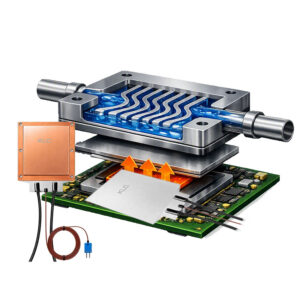
From Chip-Level Thermal Simulation to Data Center Cooling Validation
As AI accelerators and HPC processors continue to increase in power density, thermal management has become a critical factor in system performance, reliability, and energy efficiency.
KLC TTV 2.0 provides engineers with a standardized platform for evaluating thermal solutions across multiple levels of the cooling development process—from chip-level thermal simulation and cold plate validation to advanced liquid cooling development.
The combination of standardized dimensions, customizable thermal profiles, low thermal resistance, integrated temperature sensing, and multi-zone hotspot simulation provides a flexible platform for engineers developing cooling technologies for:
- AI servers
- Data centers
- GPUs
- CPUs
- AI accelerators
- ASICs
- Chiplets
- HBM
- HPC systems
- Semiconductor packages
KLC TTV 2.0 is designed to help engineering teams establish a more repeatable, measurable, and scalable thermal validation methodology for the next generation of high-performance computing.
About KLC Corporation
TAIWAN KING LUNG CHIN PTC CO., LTD. (KLC Corporation) is a Taiwan-based thermal management technology manufacturer with more than 40 years of experience in heating technology and thermal engineering.
KLC specializes in PTC heaters, flexible heaters, ceramic heating solutions, temperature controllers, automotive and EV heating solutions, medical heating solutions, and Thermal Test Vehicles (TTVs).
For semiconductor, AI, HPC, and data center applications, KLC develops customized thermal validation solutions designed to simulate chip-level thermal loads and support the evaluation of cold plates, liquid cooling systems, thermal interface materials, and advanced thermal management technologies.
By combining heating technology, thermal engineering, manufacturing capabilities, and application-specific customization, KLC provides thermal solutions for customers across international markets.
KLC Corporation
TAIWAN KING LUNG CHIN PTC CO., LTD.
Email: info@ptc-heater.com.tw
Website: www.ptc-heater.com.tw


