By KLC Corporation R&D Engineering Team
Abstract
Designing compact point-of-care (PoC) diagnostics, wearable therapeutics, and microfluidic systems requires balancing rigorous spatial constraints with zero-tolerance thermal stability. Traditional heating elements often add unnecessary bulk, fail to maintain uniform contact on curved surfaces, or lack third-party quality compliance. This paper examines how ultra-thin (0.28 mm) Polyimide (PI) flexible heater technology resolves these critical OEM trade-offs. By integrating embedded temperature sensors with ISO 9001:2015 quality control, UL recognition (cUL File: E315621), and SGS-verified RoHS/REACH compliance, KLC Corporation provides a high-reliability thermal solution for patient-adjacent and diagnostic applications.
-
The Engineering Challenge: Thermal Bottlenecks in Medical Device Miniaturization
As medical diagnostic platforms transition from central laboratories to portable, point-of-care (PoC) environments, device engineers face a persistent dual challenge: drastic physical miniaturization without compromising thermal control precision.
Accurate sample pre-heating and precise thermal cycling are crucial for biological assays (DNA/RNA extraction, PCR, and blood gas analysis). However, implementing conventional heating components into micro-architectures presents major design hurdles:
- Spatial and Weight Constraints: Rigid ceramic or metallic heaters introduce bulk and design limitations, restricting compact component layout.
- Non-Uniform Heat Transfer: Inflexible heating surfaces create micro air gaps when applied to curved surfaces (e.g., aluminum fluid channels or round tubes), leading to localized hot spots and uneven reagent warming.
- Signal Interference: Unshielded heating loops often generate electromagnetic interference (EMI) that degrades the signal integrity of highly sensitive optical or electrochemical sensors nearby.
-
Technical Architecture: Ultra-Thin Polyimide (PI) Heating Systems
To solve the conflict between space restrictions and performance requirements, KLC Corporation engineered an advanced Ultra-Thin Polyimide (PI) Flexible Heater Architecture built specifically for high-reliability medical environments.
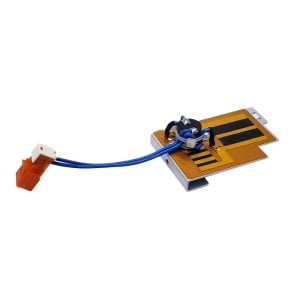
- Polyimide Outer Cover Film (Kapton® Substrate)
- Precision Etched Foil Circuit + Integrated NTC Thermistor
- Polyimide Base Insulation Layer (~0.28 mm Total Thickness)
- 3M Thermally Conductive Pressure-Sensitive Adhesive (PSA)
Core Value Propositions & Technical Advantages:
- Ultra-Thin Profile (~0.28 mm): Consisting of precision-etched foil resistive elements encapsulated in polyimide (Kapton®) film, the entire assembly measures just 0.28 mm (including adhesive layer), eliminating assembly bulk.
- Superior Surface Conformability: Capable of tight bend radii, the flexible substrate contours seamlessly around 5 mm outer diameter (OD) tubing or 3D curved enclosures, ensuring direct-contact thermal conduction and rapid heat-up.
- Closed-Loop Temperature Precision (): Direct embedding of NTC thermistors or PT1000 sensors into the flex circuit enables real-time PWM control feedback, preventing thermal overshoot and reagent degradation.
- EMI-Conscious Electrical Design: Operates across low-voltage safety ranges (3V to 230V AC/DC) with high-frequency PWM driving strategies to eliminate electrical cross-talk with sensor circuits.
-
Targeted OEM Medical Applications
| Application Field | Critical Thermal Requirement | KLC Flexible PI Solution Value |
| In-Vitro Diagnostics (IVD)
|
Uniform reagent warming without bio-molecule degradation. | Custom (24V / 9.6W) modules with integrated NTC sensors delivering stability. |
IV & Fluid Delivery Systems
|
Constant fluid line heating without continuous operation edge-lifting. | L-shaped wrap-around heaters designed for OD aluminum tubes with high-tack thermally conductive adhesive. |
| PCR Thermal Cyclers
|
Rapid heat transfer and micro-block pre-heating. | Low-profile micro-heaters providing uniform heat flux across multi-well blocks. |
| Wearable Therapeutics | Body-contoured flexibility, safety, and lightweight comfort. | Ultra-flexible low-voltage (5V) arrays bonded via 3D foam-block pressing for ergonomic contact. |

-
Verifiable Quality & Regulatory Compliance
In medical OEM procurement, component traceability and safety credentials are as vital as physical specifications. KLC Corporation verifies all product claims through established international certifications:
- ISO 9001:2015 & ISO 13486: 2016 Management System: Full production traceability from raw materials to final resistance testing.
- Verified Safety Certifications: Over 20,000 UL-approved standard models (cUL File Number: E315621) and EU CE compliance (IEC 60335-1:2010 / IEC 60335-1:2012).
- Environmental & Biocompatibility Compliance: Independently tested by SGS for strict compliance with RoHS and REACH (SVHC) directives, ensuring safety in cleanrooms and patient-adjacent settings.
- Documented Assurance: Every shipment includes standardized Resistance & Dimensional Inspection Reports alongside a formal Certificate of Conformance (CoC).
-
Conclusion & OEM Prototyping Roadmap
Ultra-thin polyimide flexible heaters offer medical device engineers a validated pathway to miniaturization without compromising thermal performance. By combining space-saving ergonomics with third-party verified regulatory compliance, OEMs can mitigate design risks and accelerate commercialization.
Engineering Prototyping & Contact Information:
KLC Corporation supports low-volume custom prototyping (MOQ 5–10 pcs) with a standard engineering turnaround of 30–35 working days.
- Technical Specifications & Datasheet: Download at the official KLC Medical Flexible Heater Product Page.
- Engineering Inquiries: Contact info@ptc-heater.com.tw for a project evaluation within 48 hours.